


Sponsorship Activation for Nonprofits
What is Sponsorship Activation?
Over the past four weeks, we’ve explored what it means to be sponsorship-ready. We’ve talked about finding sponsors that align with your mission, understanding the audiences and assets you bring to the table, developing sponsorship opportunities that create mutual value, and protecting your reputation through thoughtful partnership decisions. These are all important building blocks, especially at this time of year when many organizations are planning for the year ahead and sponsors are reviewing where they’ll invest their community dollars. That foundation matters because deciding what you want a sponsorship relationship to accomplish should come before deciding how the relationship will be activated.
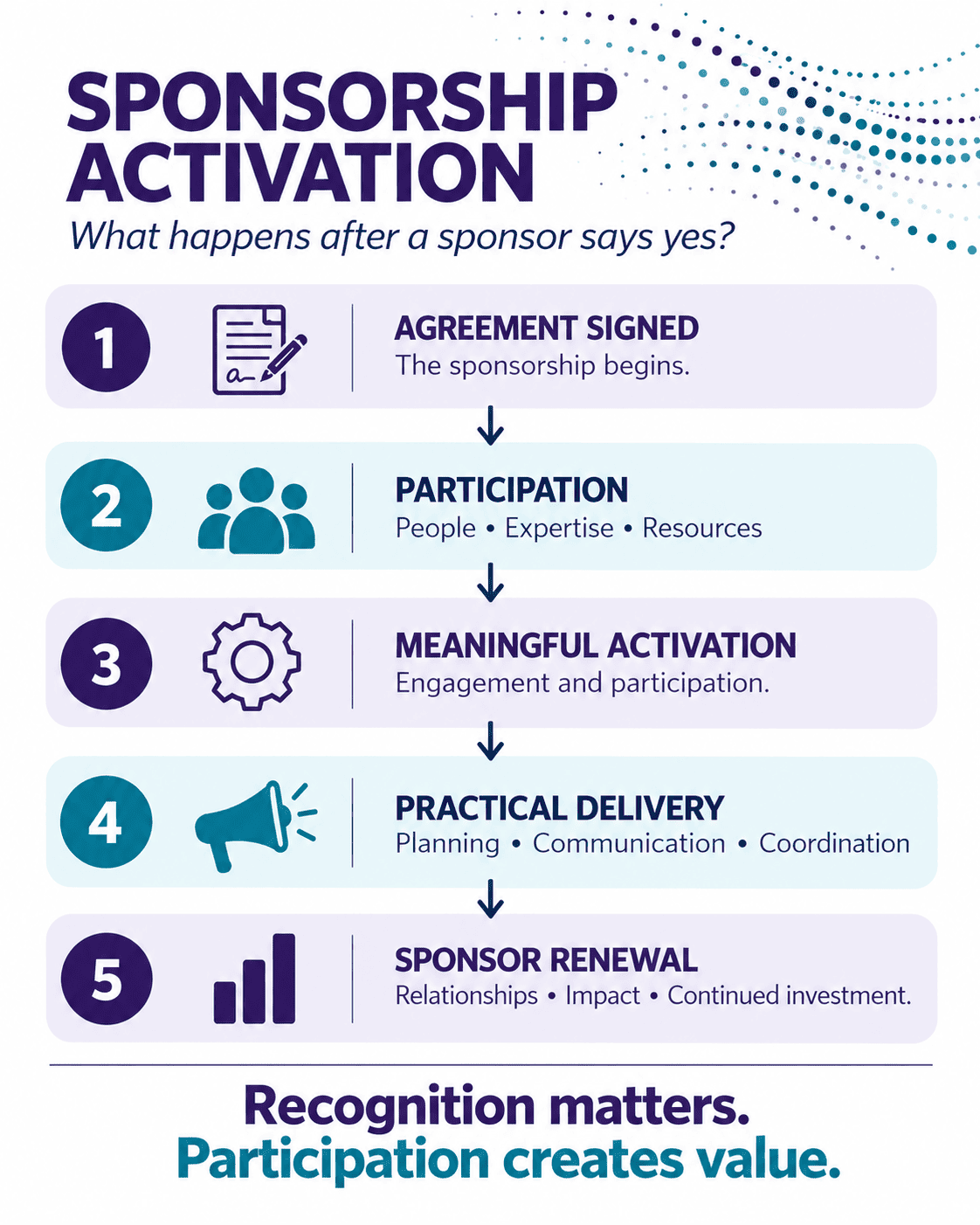
But there’s one question that often gets overlooked: what happens after a sponsor says yes? For many charities, non-profits, and post-secondary institutions, securing a sponsorship can feel like the finish line. The agreement is signed, the revenue target looks a little healthier, and everyone moves on to the next priority. In reality, that’s where the most important part of sponsorship begins. For nonprofits, charities, and post-secondary institutions, this next stage is often referred to as sponsorship activation: turning the agreement into meaningful experiences, participation, and value for both the sponsor and the organization.
The strongest sponsorships aren’t remembered because of the agreement that was signed. They’re remembered because of the experiences, relationships, and outcomes that followed. That’s what sponsorship professionals refer to as activation, but don’t let the terminology distract you. At its core, activation is simply the process of bringing a sponsorship to life through meaningful engagement and participation. Industry experts consistently identify activation as one of the key factors that separates successful sponsorships from those that deliver little more than logo visibility.
Why Sponsorship Activation Goes Beyond Logo Recognition
Industry guidance also points to alignment, activation, and measurement as connected elements of sponsorship value, reinforcing why the work that follows an agreement matters as much as the agreement itself.
For years, many sponsorship programs were built primarily around recognition. A logo on a banner. A thank-you from the stage. A social media post. A table at an event. A logo on a website. Recognition still matters. Sponsors deserve to be acknowledged for their investment and support.
The challenge arises when recognition becomes the entire sponsorship strategy. If the only thing that changes after a sponsorship agreement is that a logo appears in a few new places, it is fair to ask whether the partnership is truly creating value for either organization. Most businesses already have numerous ways to increase their visibility. What many are increasingly seeking are opportunities to engage employees, demonstrate community impact, strengthen relationships, develop future talent, and contribute to causes that align with their values. That can include employee participation and volunteer opportunities, which research has associated with greater connection, fulfilment, teamwork, and a more positive workplace experience. Sponsorship succeeds when it creates those opportunities, not simply because a logo is displayed.
Sponsorship Activation Ideas
For Nonprofits and Charities
The sponsorships people remember: Think about a sponsorship that has genuinely stood out to you. Chances are, you don’t remember the logo.
You remember the experience. Maybe employees from a local company were volunteering at a community event. Maybe a business leader shared career advice with students. Maybe a corporate team helped launch a new community initiative. What made the sponsorship memorable wasn’t the visibility. It was the participation.
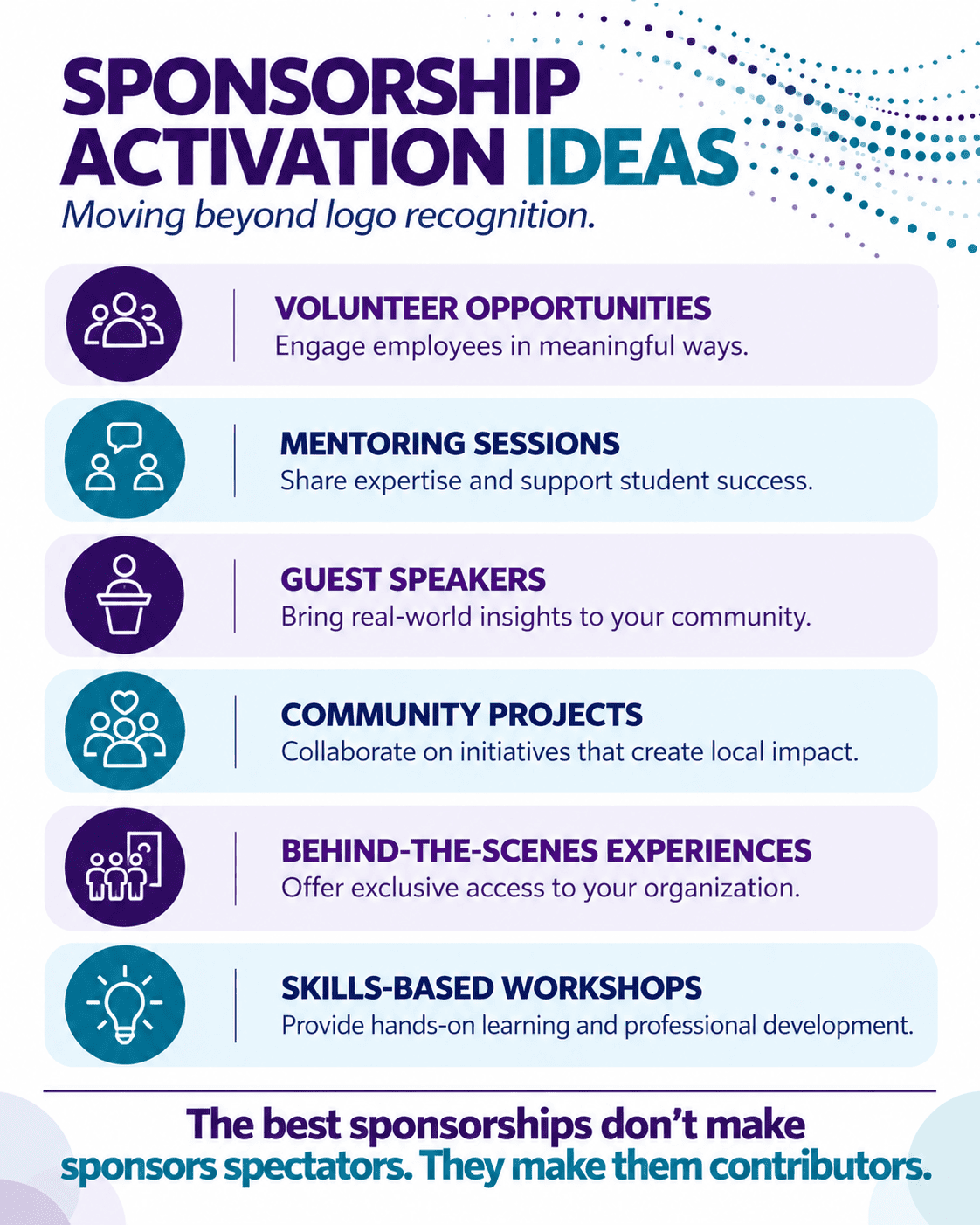
That’s what activation looks like in practice. The best sponsorships don’t make sponsors spectators. They make them contributors.
For Post-Secondary Advancement Teams
The same principle applies in post-secondary environments. Imagine a regional technology company sponsoring a student leadership conference. The standard benefits might include event recognition, website visibility, promotional opportunities, and tickets for company representatives. Now imagine taking that relationship one step further.
The sponsor’s employees participate in mock interviews with students. Leaders from the company contribute to a panel discussion about emerging workforce skills. Students have an opportunity to engage directly with professionals working in the field. The sponsorship suddenly becomes much more relevant and memorable. Students gain valuable career insights. The institution strengthens industry relationships. The sponsor develops connections with future talent and demonstrates its commitment to supporting student success.
A year later, most attendees won’t remember where the logo appeared. Many will remember the conversation that helped them think differently about their future.
How to Build Sponsorship Activation Around Participation
The best activations start with a different question: One of the most effective shifts organizations can make is moving away from asking: “How will we recognize this sponsor?” Instead you could be asking: “How can this sponsor participate?”
That question often changes the entire conversation. Sponsors frequently bring much more than financial resources. They have employees who want meaningful volunteer opportunities. They have expertise, networks, technology, communications platforms, and professional knowledge that can create additional value when thoughtfully aligned with your mission and goals. The objective isn’t to create activity for the sake of activity. Thinking about sponsor contributions beyond financial support can also uncover activation opportunities that would never appear in a traditional sponsorship package. It’s to identify opportunities where the sponsor’s contribution helps advance your mission while helping the sponsor achieve its own objectives. When participation becomes the focus, stronger ideas often emerge.
How to Create Sponsorship Activation Your Team Can Deliver
Keep it practical: One mistake many organizations make is assuming activation has to be elaborate. It doesn’t. Some of the most successful activations are surprisingly simple. A volunteer opportunity. A mentoring session. A guest speaker. A community project. A behind-the-scenes experience. A skills-based workshop. The most effective activation isn’t necessarily the largest or most creative. It’s the one that your organization can deliver well.
Every activation requires planning, communication, coordination, and accountability. Smaller organizations in particular can sometimes underestimate the capacity required to execute ambitious ideas. A modest activation that creates a meaningful experience will almost always outperform an elaborate activation that overwhelms staff and volunteers. That is why activation and delivery capacity are part of AdvanceU’s broader Sponsorship Accelerator approach: a strong idea still has to be realistic for the organization responsible for delivering it.
How Sponsorship Activation Can Strengthen Sponsor Renewal
The experiences that drive renewals: When sponsorship renewal conversations begin, organizations often focus on metrics such as attendance, impressions, website traffic, or social media reach. Those numbers certainly matter. But they rarely tell the entire story. What sponsors often remember are the moments that felt meaningful. The employee who volunteered for the first time. The student who gained confidence through a mentoring conversation. The participant whose experience improved because of the partnership. The relationships that were formed and the impact that was created together.
Those stories are difficult to capture in a dashboard. They’re also the stories that strengthen relationships and encourage sponsors to continue investing year after year.
Build Activation Into Your Sponsorship Strategy
As you begin preparing sponsorship conversations for next year, consider approaching them from a slightly different perspective. Rather than focusing only on where a sponsor’s logo will appear, think about where a sponsor’s people, expertise, and resources might make a meaningful contribution. Because sponsorship is rarely at its strongest when a sponsor simply watches from the sidelines. It’s strongest when both organizations work together to create something that neither could have achieved alone.
That’s when sponsorship stops feeling like a transaction and starts feeling like a partnership. Are you ready to evaluate your readiness across five key dimensions of sponsorship success?
- Alignment and boundaries
- Audiences, assets, and offers
- Partner fit and decision-making
- Activation and delivery
- Results and relationship management
How Strong Is Your Sponsorship Approach?
Strong sponsorship activation depends on more than what happens after an agreement is signed. It begins with alignment, a clear understanding of your value, the right partner, realistic activation, and a plan for managing results and relationships. The free AdvanceU Sponsorship Accelerator Self-Assessment helps charities, nonprofits, and post-secondary advancement teams identify strengths and gaps across those five areas.
Take the free Sponsorship Accelerator Self-Assessment and identify where to focus next.
AI Transparency Statement: AdvanceU 1st Consultants used generative AI to assist with research, organization, drafting, and editing of this article. All professional insights, interpretations, recommendation, and final editorial decisions reflect the expertise and judgement of AdvanceU.