



What Should a Sponsorship Report Include?
Beyond Logos and Attendance
Most sponsorship reports begin with good intentions. The organization wants to thank the company, confirm that everything was delivered and share enough numbers to demonstrate that the event or program was successful.
The result is often a collection of attendance figures, logo placements, social media screenshots and photographs. All of that may be accurate, but it can still leave the sponsor with an unanswered question: what did our investment actually make possible?
A useful sponsorship report has to do more than prove that an organization completed a list of activities. It should help the company understand whom it reached, how people engaged, what value was created, and whether the relationship remains worth pursuing.
In other words, the report shouldn’t read like a receipt, it should make the business case for what happened and help both parties decide what comes next.
Start Your Sponsorship Report with the Agreement
Every sponsorship report should begin by establishing exactly what it covers. Identify the event or program, the reporting period, the sponsor, the sponsorship tier, and the agreement or contractual schedule that defined the benefits.
This may sound administrative, but it establishes the integrity of everything that follows. A national sponsor involved in several events did not purchase the same opportunity as a regional exhibitor participating in one city. Their reports should not be interchangeable.
The agreement, and particularly schedule of benefits, provides the blueprint. If the sponsor was promised an exhibitor booth, stage recognition, newsletter placement, an activation, event registrations, or employee participation, the report should account for each commitment.
That record should be candid. Some benefits will have been delivered exactly as planned. Others may have been made available, but left unused because the sponsor did not provide materials or chose not to activate them. Occasionally, a promised benefit will become unavailable. When that happens, the best response is not to hide the change in the final report. The organization should speak with the sponsor as early as possible and agree on an alternative of comparable value. The report can then show what was originally promised, what changed and what was provided instead.
A sponsor’s decision not to use a benefit does not reduce the agreed price. The organization’s responsibility is to create and maintain the opportunity it sold. Its reporting responsibility is to show, transparently, what it delivered and what the sponsor chose to activate.
Yet even a perfectly completed contractual checklist cannot explain the full value of a sponsorship. The schedule of benefits may confirm that a premium booth was available. It cannot show who stopped, what conversations took place or whether the sponsor connected with the audience it hoped to meet.
The contract tells the organization what it must account for. The rest of the report explains what those commitments created.
What Attendance and Audience Data Should a Sponsorship Report Include?
A headline attendance figure is useful, but the number is not all that matters. If 300 people attended an event, the sponsor will reasonably want to know who those people were. Which sectors did they represent? What roles did they hold? Were they students, frontline practitioners, senior decision-makers, public-health leaders or community representatives? Did they come from the local area, across the province or from several regions of the country?
These details turn attendance into audience evidence.
The distinction matters because the value of a sponsorship does not come from access to an anonymous numbers. It comes from a realistic opportunity to reach people who are relevant to the company’s objectives and the organization’s work.
An organization should therefore explain how the audience aligned with what the sponsor hoped to accomplish. That does not mean promising that every person in the room noticed the sponsor, changed an opinion, or took an action. It means showing why this audience was relevant and what opportunities the sponsorship created for meaningful engagement. The organization’s responsibility to open the door, the sponsor still must choose how they walk through it.
The work of reporting starts long before the agreement is signed. An organization first has to decide what it wants the sponsorship relationship to accomplish, what it is prepared to contribute and what it will need to demonstrate. When those questions are settled early, the report has a clear purpose instead of becoming a post-event search for numbers. Reporting becomes much easier when those questions have already been answered.
How to Demonstrate Sponsorship Value Beyond Logo Placement
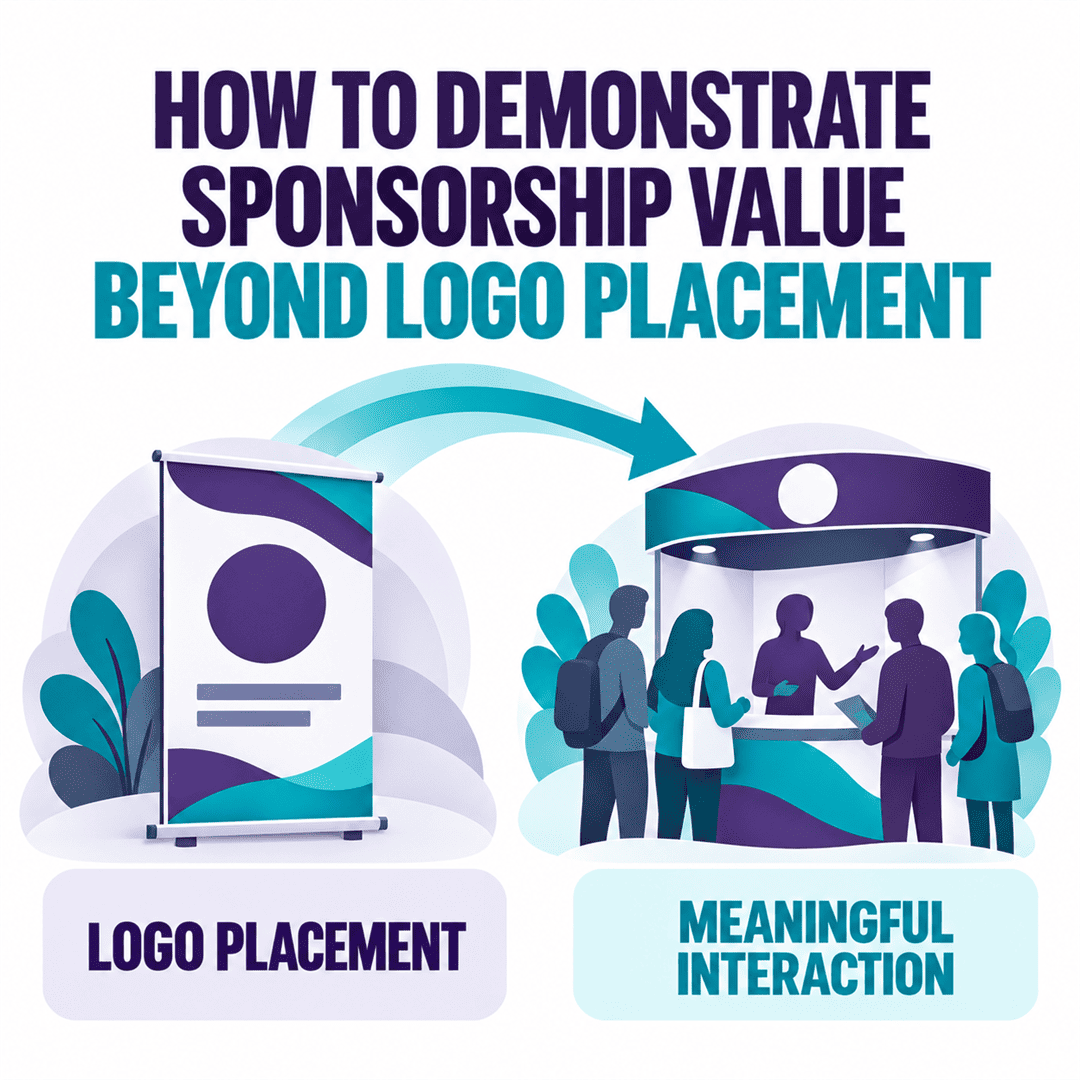
A logo shows placement. Interactions begin to show value. Recognition remains part of sponsorship. If a company was promised its logo on an event banner or in a newsletter, the organization needs to demonstrate that the placement occurred.
But recognition and engagement are not the same thing. A photograph of a sponsor’s booth confirms that the booth existed. A photograph of participants speaking with sponsor representatives begins to show how the opportunity was used. A record of booth visits, conversations, material distribution, QR activity, or follow-up requests can add further context.
The relevant evidence will depend on the event and the sponsorship. There is no universal set of metrics that automatically proves value. At a post-secondary conference, the most useful evidence might relate to student participation, conversations with faculty, employee involvement, or connections with future talent. At a community health event, it might involve engagement with practitioners, community leaders, or people with relevant lived experience. A sponsored networking space will create different evidence from a workshop, recognition opportunity, or digital campaign.
The organization needs to understand the purpose of the benefit before deciding what evidence will be useful. This is also where qualitative information becomes important. Staff observations, participant comments, sponsor feedback and carefully selected photographs can explain what the numbers alone cannot. They should not be included as decoration or as a substitute for evidence. They should help the reader understand how people experienced the sponsorship and how that experience connects with the values and outcomes that brought the two organizations together.
A sponsorship is activated when the agreement is turned into meaningful participation and experience. The fulfilment report should capture evidence of that work as it happens rather than forcing staff to reconstruct it several weeks later.
How to Measure Sponsorship Reach
Reach number needs explanation. For example, email campaigns, newsletters, social media, websites and event promotions can all contribute to sponsor visibility. These channels can produce a wide range of figures that are easy to place in a report and easy to misunderstand.
Who the email was sent to and the audience they are a part of is more meaningful that the total number of emails distributed. Which in turn, is not the same as the number of emails opened. An impression is not necessarily a unique person. A website visit does not prove that someone noticed the sponsor or followed a link. Potential reach and confirmed engagement are different forms of evidence.
A credible report tells the reader what each figure represents, where it came from and what can reasonably be concluded from it. If the organization reports newsletter opens, social impressions, website visits or link activity, it should identify the source and reporting period. Screenshots and platform reports can provide supporting evidence without turning the document into an analytics dump.
The purpose is not to make the largest possible number appear on the page. It is to give the sponsor information that can be understood, verified and used internally.
How to Measure Sponsorship Value and ROI
Companies need to understand what they received for their investment. Financial valuation tools can help an organization describe that value in a consistent way.
CPM, or cost per thousand impressions, estimates what it would cost to create a similar level of exposure through advertising. If a sponsor appeared in emails, newsletters, social media posts or website content, CPM can help place an estimated value on that visibility.
Organizations may also assign a value to direct access or engagement with a particular audience. Access to senior leaders, specialized professionals or other difficult-to-reach groups may be more valuable than general exposure because the sponsor has an opportunity to build relevant relationships. The terms used in the report need to be clear. CPA commonly means cost per action or cost per acquisition in advertising. If the organization uses CPA to mean cost per access, it should write out and define the term so the sponsor knows exactly what is being measured.
These calculations estimate sponsorship value. They do not necessarily prove the company made a financial return. Under standard marketing definitions, financial ROI requires evidence of the financial return attributable to the sponsorship and the full cost of the investment. The organization delivering the event or program will rarely have access to all of the company’s sales, lead, employee or customer data needed to make that calculation.
What the organization can demonstrate is the value it delivered: audience access, media exposure, engagement opportunities, activations and contracted benefits. If that estimated value is compared with the sponsorship fee, the result should be described as a value multiple rather than confirmed financial ROI.
Precision does not weaken the report. It makes the report more credible. Clear language allows the sponsor to understand both what the report demonstrates and what it does not.
How to Customize a Sponsorship Report Template
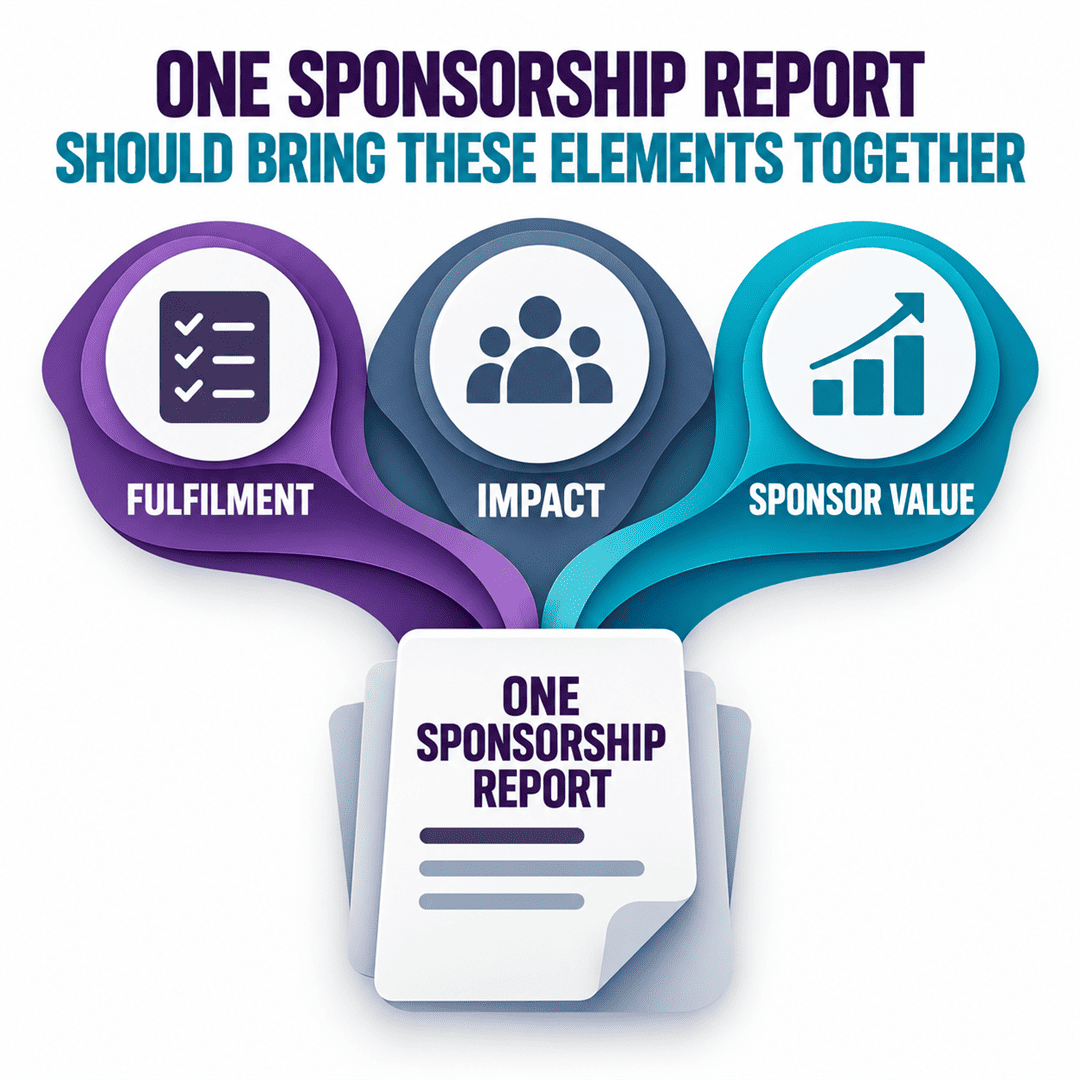
Organizations do not need separate fulfilment, impact and ROI reports. One sponsorship report should bring these elements together by showing what was promised and delivered, what happened through those commitments and how the evidence relates to the sponsor’s objectives and the organization’s intended impact.
A consistent template gives the organization a reliable reporting process, but it does not mean every sponsor should receive the same report. A defined schedule of benefits should determine which benefits, values, activations, and evidence belong in each version.
A national sponsor participating across several events may have speaking opportunities, employee involvement, recurring activations, content, digital promotion, and direct engagement with several audiences. Its report will need to account for a wider range of commitments and interactions. A smaller regional sponsor may have fewer benefits and a more focused role, so its report can be shorter while still being complete.
The difference is not simply that a larger sponsor receives more pages. The scope and depth should reflect the investment, the benefits purchased and the opportunities the sponsorship created. This is also why fulfilment and impact belong together. Delivering a booth proves that the organization kept a contractual promise. Showing how the booth was used, who engaged with the sponsor, and what came from those interactions helps explain why that promise mattered.
When Should You Send a Sponsorship Report?
The report should arrive before the conversation and nothing in it should be a surprise. This is business decision and needs to be treated as such. A fulfilment report should not be emailed as a ceremonial thank-you and then filed away. The sponsor should receive it before a scheduled debrief, along with an agenda that gives both parties time to prepare. That meeting creates space to discuss what worked, what was underused, what should change and whether the relationship should continue.
Sometimes the evidence will support renewal or expansion. Sometimes it will reveal an opportunity to redesign the sponsorship. In other cases, the responsible decision may be to close the relationship because the fit, capacity or value is no longer there. That is not necessarily a failure. Sponsorship is a business and marketing exchange, and both parties should be able to make a clear decision about whether continuing makes sense.
The report also helps the sponsor’s contact make the case internally when the organization is not in the room. When budgets are reviewed, that person needs more than a positive memory of the event. They need credible information showing what the company received, what value was created and why the relationship matters. This becomes especially important when sponsorship budgets are under pressure. Both parties need to understand what they contributed, what the relationship achieved and whether continued investment makes sense. Companies and community organizations alike both need clarity about what they contribute and what the relationship is expected to achieve.
How to Improve Your Sponsorship Reporting Process
A good report should make the next one easier. The report also has an internal audience. Leadership, the board, and the fundraisers need to understand whether the sponsorship remained aligned, what it cost to deliver, where value was created, and which problems need attention.
If gathering the evidence becomes a major project after every event, the report is exposing an operational gap. Perhaps marketing analytics were not assigned to anyone. Photographs may be scattered across personal phones. Staff may not have known which interactions to record. The sponsorship lead may be expected to assemble information from departments that were never told what would be required.
Those are not merely reporting problems. They are process problems.
An internal review can identify where responsibilities need to be clearer, where information should be stored, and how evidence collection can become part of delivery rather than an emergency after the event. That matters because a sponsorship can generate revenue while still placing unreasonable pressure on the organization. A report that ignores the internal cost and capacity required to deliver the relationship gives leadership an incomplete picture.
Sponsorship Reporting for Small Nonprofits
Smaller organizations need discipline, not an elaborate system. Smaller organizations may not have sophisticated analytics, specialized sponsorship software, or an evaluation team. Yet, they can still report credibly. The starting point is clarity about values, intended outcomes and the reason for entering the relationship. The organization needs an aligned sponsor, a clear agreement, a Schedule A that defines the benefits and a realistic plan for documenting what happens.
The available evidence may be modest. It might include a reliable audience profile, records of benefit delivery, selected engagement figures, participant feedback, sponsor observations, and photographs that show meaningful interaction. The organization should use the evidence it can gather honestly rather than imitate the reporting system of a much larger institution.
Statistics always require context. A smaller organization may not be able to prove complex attribution, but it can explain whom the sponsor reached, what opportunity was created, how people participated, and what both parties learned. The standard is not sophistication for its own sake. It is a report that is proportionate to the relationship, transparent about what happened, and useful for the decision that follows. A sponsorship report begins with the commitments made on the page. Its real value lies in showing what happened once those promises met people.
If your organization needs to strengthen its fulfilment reporting or decide how sponsorship results should guide renewal, change or responsible closure, explore AdvanceU’s Results and Relationships support as part of the Sponsorship Accelerator.
If you want to understand the broader organizational context around your sponsorship strategy:
AI Transparency Statement: AdvanceU 1st Consultants used generative AI to assist with research, organization, drafting, and editing of this article. All professional insights, interpretations, recommendation, and final editorial decisions reflect the expertise and judgement of AdvanceU.
Scott Blythe
October 30, 2026 at 10:35 amSources and Related AdvanceU Posts:
Marketing Accountability Standards Board, “Sponsorship Accountability Part 5: Measurement.”: https://themasb.org/sponsorship-accountability-part-5-measurement/
IAB Canada, “Glossary of Terms.”: https://iabcanada.com/wp-content/uploads/2019/03/IAB-Canada-Glossary-of-Terms-English2019.pdf
AdvanceU, “Do You Want a Corporate Sponsor or Just Their Money?”: https://advanceu1st.com/2026/08/21/do-you-want-a-corporate-sponsor-or-just-their-money/
AdvanceU, “Sponsorship Activation for Nonprofits.”: https://advanceu1st.com/2026/09/18/what-happens-after-a-sponsor-says-yes/
AdvanceU, “When Sponsorship Budgets Get Tighter, What Makes a Partnership Worth Keeping?”: https://advanceu1st.com/2026/09/07/when-sponsorship-budgets-get-tighter-what-makes-a-partnership-worth-keeping/