


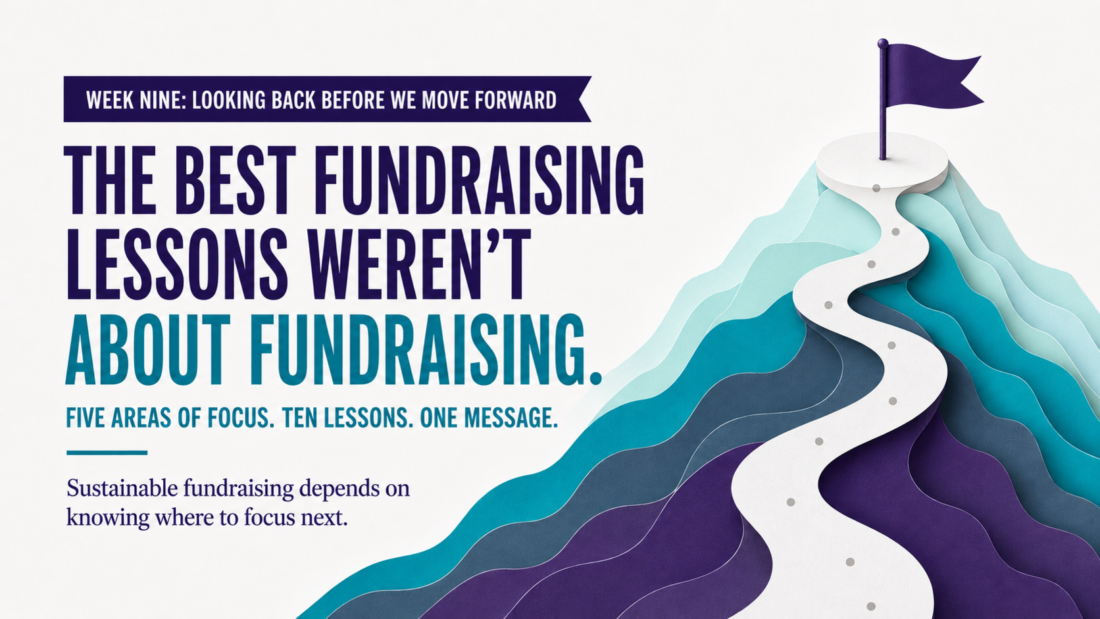
Looking Back Before We Move Forward
10 Things We Learned About Sustainable Fundraising
Over the past eight weeks, we’ve explored questions that most of us have asked at one point or another.
- How do we get more donors?
- How do we keep them?
- Why aren’t our campaigns producing what we hoped?
- Why does fundraising still feel hard, even when everyone is working incredibly hard?
What started as a series about fundraising slowly became something else. It became a conversation about organizational readiness. Because if there’s one thing many of us have discovered the hard way, it’s that fundraising problems are rarely just fundraising problems.
- They are usually signals.
- Signals about alignment.
- Signals about capacity.
- Signals about relationships.
- Signals about trust.
As we close this series, here are ten lessons that kept showing up again and again. Not as theories. As realities many of us are living every day.
Revenue & Relationships
Lesson 1: More Donors Is Rarely the Real Problem
Most organizations don’t suffer from a complete absence of donors. They suffer from an inability to consistently retain and grow the relationships they already have. When revenue feels unstable, the instinct is often to focus on acquisition. But replacing donors is not the same thing as growing donor relationships.
Growth happens when supporters stay.
Lesson 2: The Second Gift Is More Important Than the First
The second gift is a decision. It signals that trust is beginning to form. Many organizations spend significant time attracting first-time donors while having little structure for what happens afterward.
The journey between gift one and gift two may be the most overlooked part of fundraising.

Data & Infrastructure
Lesson 3: Campaigns Don’t Create Problems. They Reveal Them
A campaign applies pressure. Pressure exposes whatever already exists underneath. When campaigns struggle, they often reveal issues with governance, planning, leadership alignment, communications, relationship management, or internal systems.
The campaign isn’t always the problem. Sometimes it’s simply making the real problem visible.
Lesson 4: Major Gifts Begin Long Before Major Gift Asks
Many organizations believe they need to find major donors. Often what they really need is the organizational capacity to build major donor relationships. Major gifts grow from trust, consistency, stewardship, and leadership engagement.
They are usually the result of a healthy system, not a standalone tactic.

Planning & Alignment
Lesson 5: Activity Is Not the Same Thing as Progress
Most fundraisers we know are not looking for more work. They already have plenty.
The challenge isn’t usually effort. The challenge is deciding which work deserves attention and which work does not. Being busy can feel productive. But sustainable growth comes from focus.
Lesson 6: A Strategy Is a Series of Choices
A fundraising strategy is not a list of everything the organization hopes to do. It’s a set of decisions.
Which opportunities are credible? Which relationships matter most right now?
What will receive less attention? Without those decisions, even good strategies eventually get replaced by the next urgent idea.

Governance & Leadership
Lesson 7: Fundraising Cannot Carry the Organization Alone
Fundraising is visible. Because it is visible, it often receives both the credit and the blame. But sustainable fundraising depends on leadership. Board engagement. Communications. Programs. Stewardship. Data. Operational capacity. Fundraising can lead revenue conversations. It cannot single-handedly create organizational readiness.
Lesson 8: Readiness Is More Valuable Than Urgency
Many campaigns begin because the need feels urgent. The need is usually real. But urgency does not automatically create readiness. Successful fundraising happens when organizations understand why a campaign matters, what success looks like, who owns what, and what support the campaign will require. Readiness allows effort to produce results.

Community & Communications
Lesson 9: Donors Experience Organizations, Not Departments
Supporters don’t distinguish between fundraising, communications, operations, programs, or governance.
They experience one organization. Every interaction contributes to trust. Every interaction contributes to reputation. Every interaction becomes part of their relationship with the mission. That’s why donor journeys matter. Not because they’re a fundraising tactic. Because they’re a trust-building process.
Lesson 10: Clarity Is the Most Underrated Resource in the Sector
Throughout this series, one lesson connected everything else. When organizations gain clarity about what is actually holding them back, priorities become easier.
- Decisions become easier.
- Conversations become easier.
- Fundraising becomes easier.
Not because the work disappears. But because the organization finally knows where to focus.

One Final Thought
The biggest lesson from these eight weeks might be this: most fundraising challenges are not solved by doing more. They’re solved by understanding what matters most. The organizations that grow sustainably are not always the organizations with the largest budgets, the biggest teams, or the most sophisticated campaigns.
Often, they are the organizations with the clearest understanding of who they are, what they are trying to accomplish, and what needs to happen next. If this series has reinforced anything, we hope it is that you do not have to solve every challenge at once. You only need to identify the next most important one. That is where progress begins.
Take the free Prioritization Diagnostic and discover which organizational lever deserves your attention next.
No Comments