


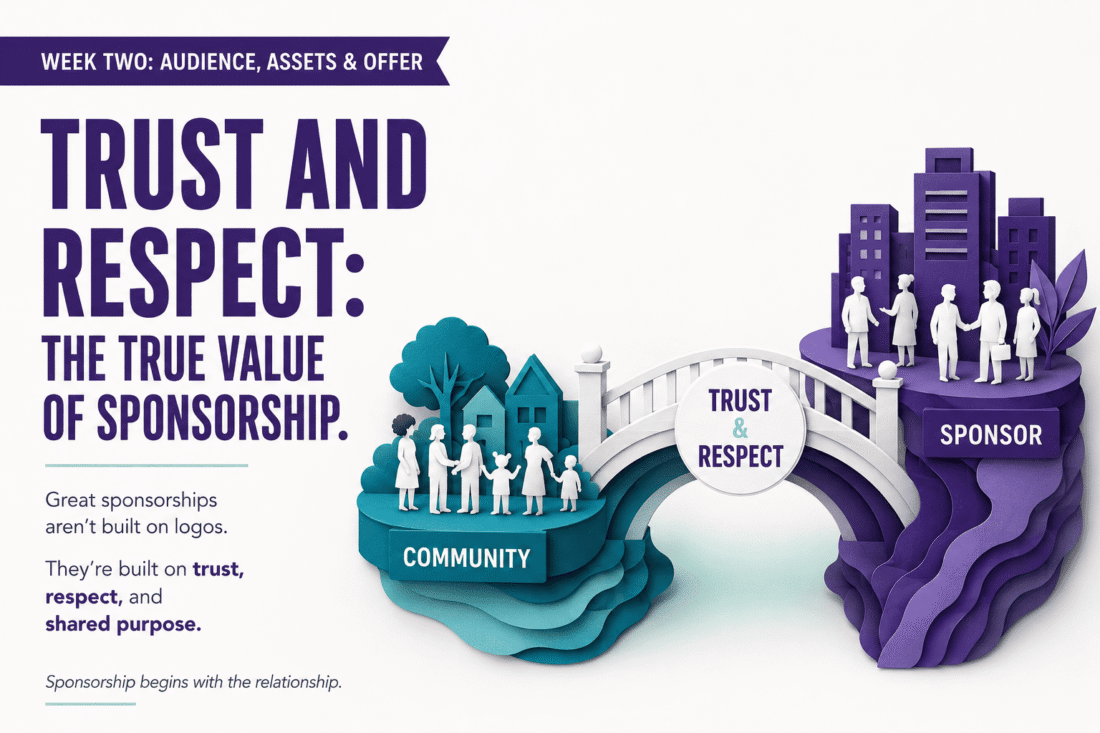
Trust and Respect: The True Value of Sponsorship
Last week, we asked a difficult but necessary question: “Do you want a corporate sponsor or just their money?”
Before an organization begins approaching companies, it needs clarity about what sponsorship should accomplish, what it is prepared to offer, what it wants to protect, and where its boundaries are. Without those conversations, even the most promising sponsorship opportunity can create confusion, unrealistic expectations, or strain on the very relationships the organization hopes to build.
This week, we want to explore a different question.
What is the true value of a sponsorship?
Many organizations answer with a list.
- Logo placement.
- Event signage.
- Website recognition.
- Tickets
- Social media posts.
Those assets matter. They have a role to play in sponsorship. But they are not where sponsorship value begins. The strongest sponsorship partnerships are built on something much less visible and far more valuable:
Trust and respect.
Trust is what allows a nonprofit or post-secondary institution to introduce a company to its community. Respect is what allows a company to support an organization’s mission without attempting to control it. When both are present, sponsorship becomes a partnership. When either is missing, sponsorship becomes a transaction.
The Foundation Every Sponsorship Relationship Needs
One of the most common challenges we see among charities and advancement teams is the belief that they have very little to offer sponsors. They look at their budgets, event attendance, marketing reach, or social media numbers and assume larger organizations possess all the valuable sponsorship assets. That is rarely true.
Many organizations overlook the foundation that took years to build: the trust of the people and communities connected to their work.
- Trust from donors.
- Trust from volunteers.
- Trust from clients.
- Trust from students.
- Trust from alumni.
- Trust from the communities they serve.
The reality is that sponsors can purchase advertising almost anywhere. They can buy impressions, clicks, digital reach, and exposure every day. What they cannot easily buy is credibility within a community. They cannot buy authentic relationships. They cannot buy the trust an organization has earned over years of delivering meaningful work.
That trust is often the foundation upon which sponsorship value is built.
Sponsors Are Looking for More Than Exposure
For many years, sponsorship discussions focused heavily on visibility: How many people attended? How many logos appeared? How many impressions were generated?
Those questions still matter, but they are no longer the only questions sponsors are asking. The Canadian Sponsorship Landscape Study continues to show increasing emphasis on audience alignment, activation, measurable outcomes, and strategic value. Measurement and return on objectives have become among the most significant concerns for sponsors across Canada.
Corporate community investment professionals are facing similar expectations. Organizations participating in the LBG Canada Standard have collectively tracked and verified more than $8 billion in community investment and over 29 million employee volunteer hours, reflecting the growing importance of accountability, impact measurement, and demonstrating value from community investments.
In practical terms, sponsors want more than visibility.
They want to understand how a partnership helps them connect with communities, engage employees, support social impact, and demonstrate meaningful investment. At the same time, nonprofits want sponsors who genuinely support their mission rather than simply seeking promotional opportunities.
Trust and respect sit at the centre of both expectations
Not All Sponsorship Assets Are Equal
This is where many sponsorship conversations become challenging. Organizations often build sponsorship packages by listing everything they can offer.
- A logo on a website.
- A newsletter mention.
- An event banner.
- Recognition during a ceremony.
While these benefits may have value, they do not all create the same value.
As outlined in AdvanceU’s Sponsorship Asset Checklist, sponsorship assets should be evaluated based on factors such as uniqueness, audience access, and exposure. Assets that combine these characteristics generally create significantly greater value than assets that offer only one.
More importantly, not all assets create the same level of trust. A banner may create awareness. A trusted introduction to an audience creates connection. A logo may create visibility. Participating in meaningful community impact creates credibility. A social media mention may generate attention. An opportunity for employees to engage directly with a cause may create lasting value.
The difference matters. Sponsors can purchase visibility almost anywhere. Trust must be earned.
Why Some Assets Matter More
The most valuable sponsorship assets are often not the most obvious.
Organizations frequently focus on what they can easily see instead of what sponsors genuinely value. A community organization may have trusted relationships with families, volunteers, and local leaders. A university may bring together students, alumni, faculty, researchers, and industry partners. A nonprofit may have unique expertise, powerful impact stories, or deep connections within a particular community. These assets are difficult to replicate. They are also difficult to purchase elsewhere.
That is why they are valuable.
The strongest sponsorship opportunities are rarely built around a logo placement alone. They are built around meaningful opportunities to connect, contribute, participate, and create shared value.
Knowing Your Worth
Many organizations eventually ask the same question: How much should we charge for sponsorship?
Unfortunately, there is no universal formula. Too often, organizations look at another sponsorship package and attempt to match the pricing. Yet sponsorship value is not determined by what another organization charges. It is determined by the value of the relationship being created. The audiences being reached. The experiences being offered. The trust being shared. The outcomes being achieved. A local charity serving a highly engaged community may provide greater value to a sponsor than a larger organization with significantly more visibility. A university research initiative may create greater value than a larger event simply because it offers unique access to knowledge, expertise, or future talent.
Value is not determined by volume alone. Value is determined by relevance.
Respect Matters Too
Trust often receives most of the attention in sponsorship discussions. Respect deserves equal consideration.
Sponsors need to respect the mission, values, and boundaries of the organizations they support. Organizations need to respect the objectives, expectations, and investment sponsors bring to the relationship. Healthy sponsorships recognize that both parties contribute something valuable. The nonprofit contributes community trust, impact, expertise, and relationships. The sponsor contributes funding, resources, knowledge, employee engagement, influence, or other forms of support. Neither partner should view the relationship as a favour.
The best sponsorships succeed because both sides recognize and respect the value each brings to the table.
Before Building Your Next Sponsorship Package
Before creating another sponsorship proposal, take a step back. Think beyond logos, benefits, and sponsorship levels.
Ask yourself:
- What trust has our organization earned?
- What relationships have we built?
- What communities do we serve?
- What experiences do we create?
- What opportunities can we realistically deliver?
- What value would a sponsor genuinely find difficult to find somewhere else?
The answers to those questions often reveal the organization’s most valuable sponsorship assets. And in many cases, they already exist.
The Real Value of Sponsorship
Trust and respect are the foundation beneath that value. They allow the organization to bring its relationships into a sponsorship without treating its community as something a company can simply buy.
Understanding your audiences, assets, and offer is one part of determining whether your organization is ready to pursue sponsorship. The Sponsorship Accelerator examines this alongside alignment and boundaries, partner fit and decision-making, activation and delivery, and results and relationships.
Take Sponsorship Accelerator Self-Assessment
Complete 18 questions in approximately 20 minutes. AdvanceU will review your responses and prepare a concise report identifying your strongest foundations, the earliest issue preventing progress, the risks requiring attention, and what to address now, next, and later.
Transparency Note: AdvanceU 1st Consultants used generative AI to support the research, organization, drafting, and editing of this article. The perspective, professional experience, analysis, and final editorial decisions are ours. Research claims and sources were reviewed before publication.