


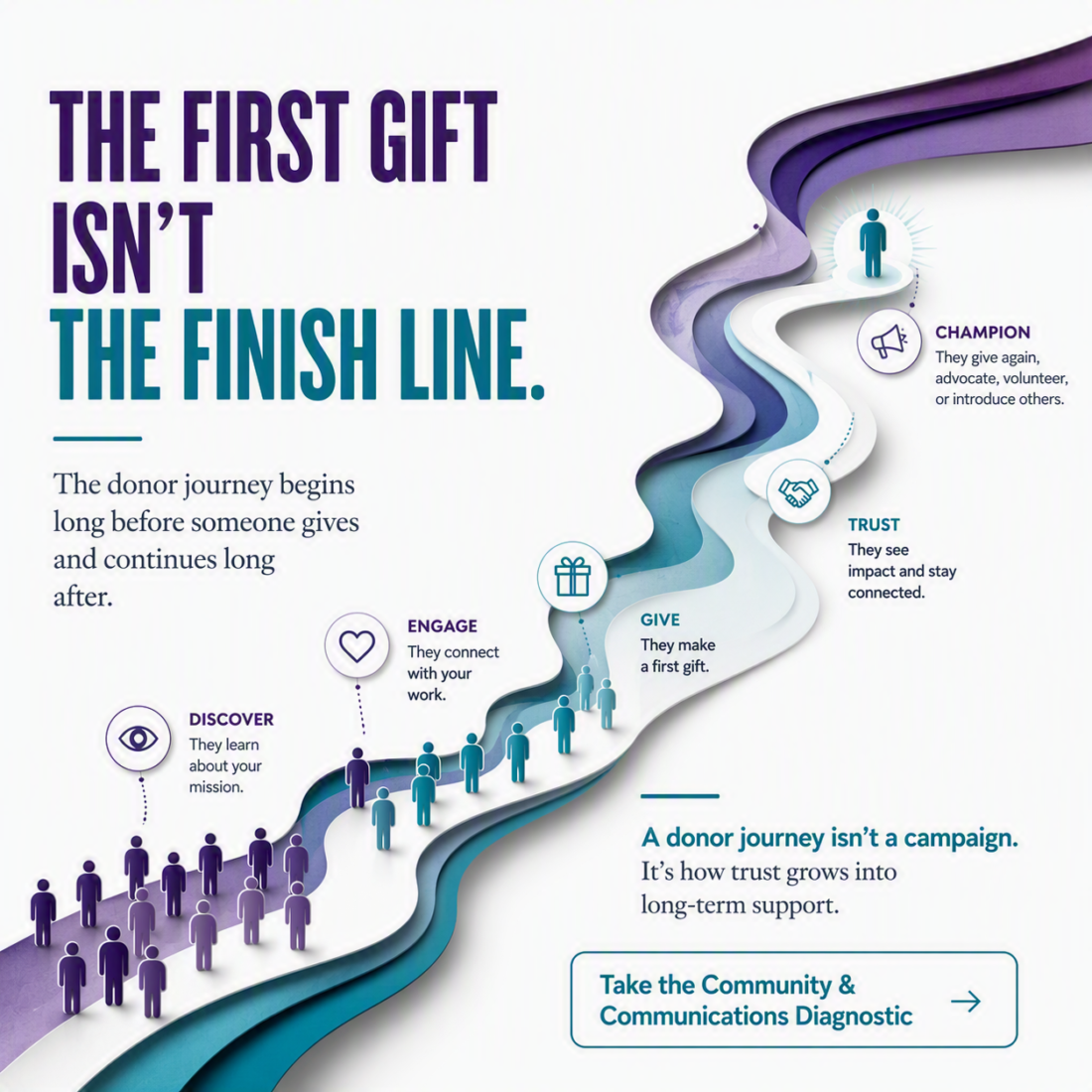
What Is a Donor Journey? (And Why It Matters More Than You Think)
Over the past several weeks, we’ve been exploring a series of questions that many nonprofit leaders and fundraisers ask:
How do we raise more money?
What actually makes a fundraising campaign successful?
Why don’t first-time donors give again?
How do we create more predictable revenue?
These are important questions. But they all point to a larger issue that often goes unnoticed. Many organizations are working incredibly hard to acquire donors while paying far less attention to what happens after someone first engages with them.
That is where the donor journey comes in.
A Donor Journey Is Not a Fundraising Strategy
A donor journey is the experience someone has with your organization over time. The decision on how donors are engaged is not a fundraising responsibility, but an organizational one. It begins before they ever make a gift. It includes every interaction they have with your mission, accessing a service need from your organization, your staff, your volunteers, your leadership, your communications, and your community.
For some people, the journey begins with a social media post. For others, it starts through a volunteer experience, an event, a community conversation, or a referral from someone they trust.
A donation is simply one moment within that broader relationship. The challenge is that many organizations unintentionally treat the gift as the destination rather than part of the journey.
Why This Conversation Matters Now
Across Canada, charities are facing a challenging environment. Organizations are being asked to do more with fewer resources. Fundraising teams are balancing donor relationships, communications, events, grant applications, reporting requirements, and organizational priorities simultaneously. At the same time, donor retention continues to be a sector-wide challenge. Research consistently shows that retaining existing donors is significantly more sustainable than continuously replacing those who leave. CanadaHelps notes that donor stewardship, acknowledgement, and ongoing communication are critical drivers of repeat giving and long-term support. Sources listed in first comment.
This is why conversations about donor journeys are becoming increasingly important. They encourage organizations to shift their focus from individual fundraising activities to the overall experience supporters are having.
What We've Learned from Previous Conversations
In our recent article on first-time donor retention, we explored a simple but important reality: the problem is not always getting the first gift. The greater challenge is creating a reason for the second gift. As we discussed, adding more donors to the top of the funnel does little if supporters are quietly leaving through the bottom.
That creates a cycle where organizations are constantly replacing relationships rather than building them. This pattern reflects broader sector concerns around retention and long-term engagement. Sources listed in first comment.
Similarly, in our discussion about fundraising campaigns, we explored how successful fundraising is rarely about a single campaign, event, or appeal.
The strongest results emerge when fundraising activities align with organizational priorities, communications, and relationship-building efforts. A donor journey is where all of those elements come together.
The Journey Is Really About Trust
When most people think about fundraising, they think about donations. Donors usually think about trust.
Trust develops through experiences.
- Did the organization communicate clearly?
- Did they follow through on what they promised?
- Did they acknowledge support appropriately?
- Did they demonstrate impact?
- Did they continue the relationship after receiving the gift?
CanadaHelps identifies acknowledgement, personalized communication, and impact reporting as some of the most important components of donor stewardship and long-term donor engagement. Sources listed in first comment. In other words, donor retention is often less about fundraising and more about relationship management and the connection of this mission that is reinforced or compromised when it is organizationally focused versus mission-based culture.
Where Organizations Commonly Struggle
Most organizations are not lacking commitment. Most are lacking capacity.
Communications happen. Stewardship happens. Board engagement happens. Community engagement happens. Fundraising happens.
The challenge is that these activities are frequently managed independently of one another. The donor journey is a series of disconnected interactions instead of a coherent relationship. For smaller charities, foundations, and advancement teams, this challenge is particularly common because responsibilities are often spread across a small number of staff members. As we noted previously, when multiple people are separate functions of fundraising, communications, stewardship, grants, and reporting, it becomes difficult to maintain consistency and act strategically to move the relationship forward in a donor-focused manner. Sources listed in first comment.
This Is Really a Community and Communications Conversation
One of the reasons we included Community & Communications as a core pillar within the Prioritization Diagnostic is because donor relationships do not exist in isolation. They are part of a larger ecosystem of constituent relationships. Donors, volunteers, partners, alumni, community members, staff, and board members all experience your organization differently. When organizations communicate intentionally, seek feedback, share outcomes, and create opportunities for meaningful engagement, trust tends to strengthen across the entire community. And, when trust strengthens, fundraising often becomes easier.
Not because people are being asked more often. Because they better understand their role in advancing the mission.
A More Helpful Question
Many organizations ask: “How do we get more donors?”
A different question may be more useful: “What experience are people having when they engage with us?”
That question shifts attention from transactions to relationships. It encourages organizations to think about stewardship before solicitation, engagement before campaigns, and community before revenue.
Most importantly, it helps clarify which activities are actually moving relationships forward.
Final Thought
A donor journey is not a marketing funnel.
It is not a campaign calendar.
And it is not a fundraising tactic.
It is the cumulative experience of being in relationship with your organization. When organizations understand that journey, they often discover that the path to stronger fundraising is not necessarily more activity. It is greater clarity about which relationships matter most, which touchpoints build trust, and how communications, stewardship, and engagement work together to move supporters from awareness to advocacy. That is where sustainable growth begins.
Take 10mins to fill out a survey on your Communications and Community engagement to receive your free self-assessment report: Fill out form
___________________________________
Suggested AdvanceU Internal Links
Add hyperlinks to the following previously published articles within the body of the article:
- How Do We Raise More Money?
- What Actually Makes a Fundraising Campaign Successful?
- Why First-Time Donors Don’t Give Again
- Fundraisers: Leading the Conversation on Priorities and Alignment
These links create a natural progression through the first eight weeks and position the Prioritization Diagnostic – Community & Communications assessment as the logical next step rather than a sales pitch.
Scott Blythe
August 6, 2026 at 3:54 pmThese links create a natural progression through the first eight weeks and position the Prioritization Diagnostic – Community & Communications assessment as the logical next step rather than a sales pitch.
External Links for sources from week eight.
Manzano, P. (2024, July 23). Stewardship and Reporting for End of Year. CanadaHelps. https://www.canadahelps.org/en/charity-life/stewardship-and-reporting-for-end-of-year/
Association of Fundraising Professionals. (2026). Donor Retention Strategy for Fundraising Teams (2026). AFP Career Center. https://careers.afpglobal.org/career-resources/finding-talent-8/donor-retention-strategy-for-fundraising-teams-2026-41
AFP Toronto. (2022, January 12). Five Tips for Strategic Donor Retention. https://afptoronto.org/blog/five-tips-for-strategic-donor-retention/
Goldberg, D. (2024). 10 Essential Policies for Canadian Charities & Nonprofits. Charity Law Group. https://www.charitylawgroup.ca/charity-law-questions/ten-policies-every-canadian-charity-nonprofit-should-have-in-place
CanadaHelps. Digital Donor Retention: Achieve Fundraising Success with Current Donors. https://www.canadahelps.org/en/free-download-digital-donor-retention-achieve-fundraising-success-with-current-donors/