


How Do I Increase Donor Retention?
The first gift felt like a win.
No second gift came. No note went out beyond the automated receipt. No one followed up to find out why. The team moved on to the next campaign because there wasn’t time to do anything else.
This is not a story about one donor. It’s the most common pattern in the sector right now, and it’s invisible until someone goes looking for it.
The Number That Tells the Real Story
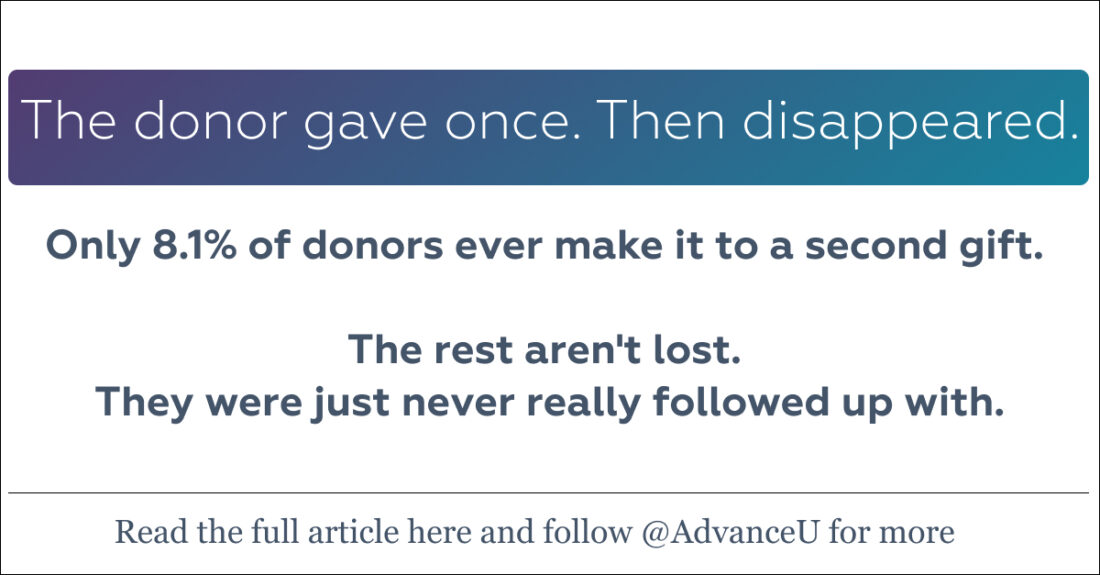
According to the AFP Fundraising Effectiveness Project Q4 2025 Report, donors who gave for the first time last year and gave again this year, the new-retained segment, made up just 8.1 percent of total donors. That figure is down 8.7 percent year over year, the weakest-performing lifecycle segment the report tracks.
Read that number again.
Out of every donor an organization has on file, fewer than one in ten are people who gave a first gift and came back for a second. That is the entire bridge between a one-time transaction and a donor relationship, and it is shrinking.
Here is what makes that number worth sitting with rather than just noting. Donors who do make it across that bridge, who give a second time, retain at 59.3 percent going forward. That is more than three times the rate of brand-new donors. The behaviour of a donor who has given twice looks nothing like the behaviour of a donor who has given once. Something happens in between that changes the relationship entirely, or fails to happen, and that failure is where most organizations are quietly losing the revenue they spent money and effort to acquire in the first place. Access the links to this in the comments.
The Question Nobody at the Board Table Asks
If a board member asked your Executive Director what happens to a donor between their first gift and their second, could anyone in the room answer with an actual process? Or only a guess?
Most boards have never asked that question, because it feels like a development detail, something operational, something below the level a board should be tracking. But a board that cannot answer that question is approving revenue targets without knowing whether the organization can actually keep what it acquires. The target itself becomes a guess dressed up as a plan.
This is not a criticism of boards. It is a description of where governance attention typically goes. Boards track the number of new donors acquired, the dollars raised, the campaign that hit or missed its goal.
Almost none track what happens in the gap between gift one and gift two, because no one taught them that gap was theirs to ask about.
Why This Isn't About Trying Harder
Most development teams already know, in some form, that they should be doing more stewardship. Ask any fundraiser and they will tell you a thank-you call matters, that an impact update matters, that personal acknowledgment matters.
They are not short on knowledge. They are not even short on intention.
What they are short on is infrastructure. A system that automatically flags a first-time donor and triggers a defined stewardship sequence, regardless of who is busy, who is on vacation, or what fire is burning that week. Without that system, stewardship becomes something that happens when someone remembers, and remembering is not a strategy.
This is the distinction that gets missed constantly in this sector. A retention problem that looks like a donor relations failure is very often a data and infrastructure failure wearing a donor relations costume. The fix gets aimed at the wrong target. Teams get told to try harder, to be more personal, to write better thank-you notes. Meanwhile the actual gap, the absence of a system that runs the same way every time regardless of who is at their desk, never gets addressed.
Until that gets named correctly, the fix keeps landing back on the development team’s shoulders instead of on the infrastructure underneath them.
Where to Start
You don’t need a full CRM overhaul to find out where your stewardship breaks down.
You need an honest, structured look at four things: whether you know your retention rate and have a plan for lapsed donors, whether acknowledgement happens consistently, whether you’re reporting impact back to donors, and whether engagement deepens over time or stalls after the first thank-you.
If stewardship is the one place you suspect the gap is, the Stewardship Lever measures exactly that. Free 9-question survey, about 7 to 10 minutes, scored report showing where your infrastructure is strong and where it isn’t.
Take the free Stewardship Lever: Prioritization Diagnostic Stewardship Lever – Fill out form
If you’d rather see stewardship alongside the other four areas that drive sustainable revenue, the full Prioritization Diagnostic covers all five domains in one pass.
Start your free Prioritization Diagnostic: Prioritization Diagnostic Self-Assessment – Fill out form
(Note: each is a separate form, so pick the one that fits what you want to know right now.)
Scott Blythe
June 18, 2026 at 3:21 pmData referenced in this post:
AFP Fundraising Effectiveness Project, Q4 2025 Report, Donors by Life Cycle: https://publications.fepreports.org/donors-by-life-cycle/
AFP Fundraising Effectiveness Project, Q4 2025 Report, Retention by Donor Type: https://publications.fepreports.org/retention-by-donor-type/