


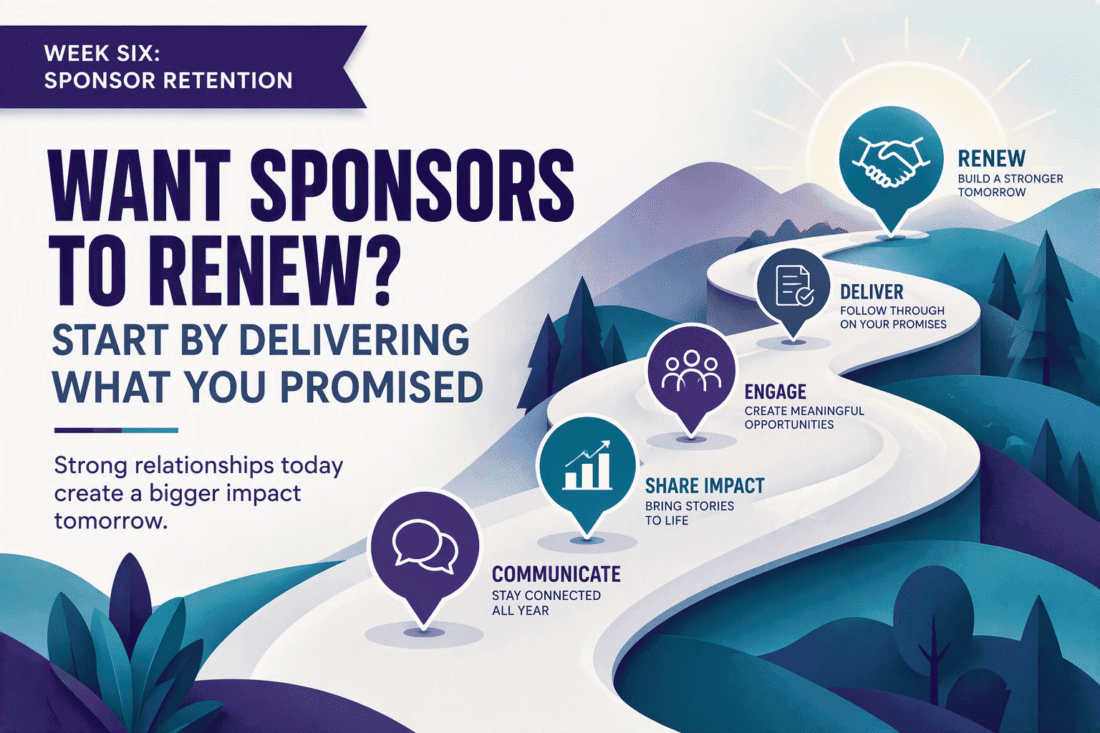
Sponsor Retention Strategies: How to Keep Sponsors Coming Back
Over the past five weeks, we’ve explored how to identify the right sponsors, uncover your organization’s sponsorship assets, align opportunities with business goals, and build stronger corporate partnerships.
Now it’s time to focus on what happens after a sponsor says yes.
Because while securing sponsorship is important, sponsor retention is what creates long-term value. Organizations that consistently renew sponsors year after year aren’t necessarily the ones with the largest events, audiences, or budgets. They’re the ones that deliver on their promises, communicate effectively, and create a partnership experience sponsors want to continue.
A sponsorship agreement can feel like a major victory. After weeks or months of conversations, meetings, emails, and proposal revisions, a company decides to invest in your organization. There’s excitement, relief, and a renewed sense of possibility. You begin thinking about the impact that investment will create and the opportunities it will open for the people you serve.
And then reality shows up.
The event still needs to happen. Social media content needs to be created. Volunteers need to be coordinated. Recognition commitments must be fulfilled. Reports need to be prepared. Relationships need ongoing attention.
In other words, the sponsorship may be secured, but the partnership is just beginning.
It’s a challenge many charities, nonprofits, and post-secondary institutions know well. The effort required to attract sponsors often receives the majority of attention, while the effort required to keep them can be underestimated. Yet when sponsors decide whether to renew their support, what they remember most is rarely the proposal or sponsorship package itself. They remember the experience of working with your organization.
Did communication feel easy?
Were commitments fulfilled?
Did they feel valued?
Did they understand the impact of their investment?
Those questions matter because the strongest sponsorships aren’t built on benefits. They’re built on trust.
Research from Bridging Perspectives: Nonprofit Views on Corporate Social Impact in Canada found that nonprofits place significant value on strong individual relationships and long-term corporate relationships, often rating them more highly than the amount of funding received. The study found that 81% of respondents value strong personal relationships and 79% value long-term corporate relationships.
That’s why one of the most important questions an organization can ask isn’t: “How do we get more sponsors?” It’s: “Can we consistently deliver the experience we want sponsors to have?”
Why Strong Sponsor Relationships Matter for Sponsor Retention
There’s often a tendency to think sponsorship decisions are driven primarily by audience size, logo visibility, or event attendance. While those factors are important, they’re only part of the story.
Today’s sponsors are looking for authentic ways to connect with communities, engage employees, demonstrate social impact, and build trusted relationships. At the same time, nonprofits are placing increasing value on long-term, partnership-oriented relationships that go beyond financial support.
When both sides view sponsorship as a partnership rather than a transaction, the relationship becomes stronger, more rewarding, and more sustainable. The most successful sponsorships aren’t built because a package looked attractive on paper. They’re built because everyone involved feels the partnership is working.
How Sponsorship Fulfillment Improves Sponsor Retention
When a sponsorship agreement is signed, expectations become reality. The promised benefits need to be delivered. Recognition commitments need to happen. Volunteer opportunities require coordination. Results need to be captured and communicated. Someone needs to answer questions, provide updates, and ensure the sponsor feels connected to the work they are helping make possible. Research published in Building Resilient Partnerships: How Businesses and Nonprofits Create the Capacity for Responsiveness found that sustainable nonprofit-business partnerships are strengthened when organizations develop the capacity to be responsive to one another and work collaboratively through change.
Individually, none of these responsibilities seem overwhelming. Together, they require planning, communication, and coordination. In most organizations, sponsorship delivery involves multiple people. Marketing and communications teams, program staff, volunteers, leadership teams, faculty members, student services professionals, and event staff may all play a role in creating the sponsor experience.
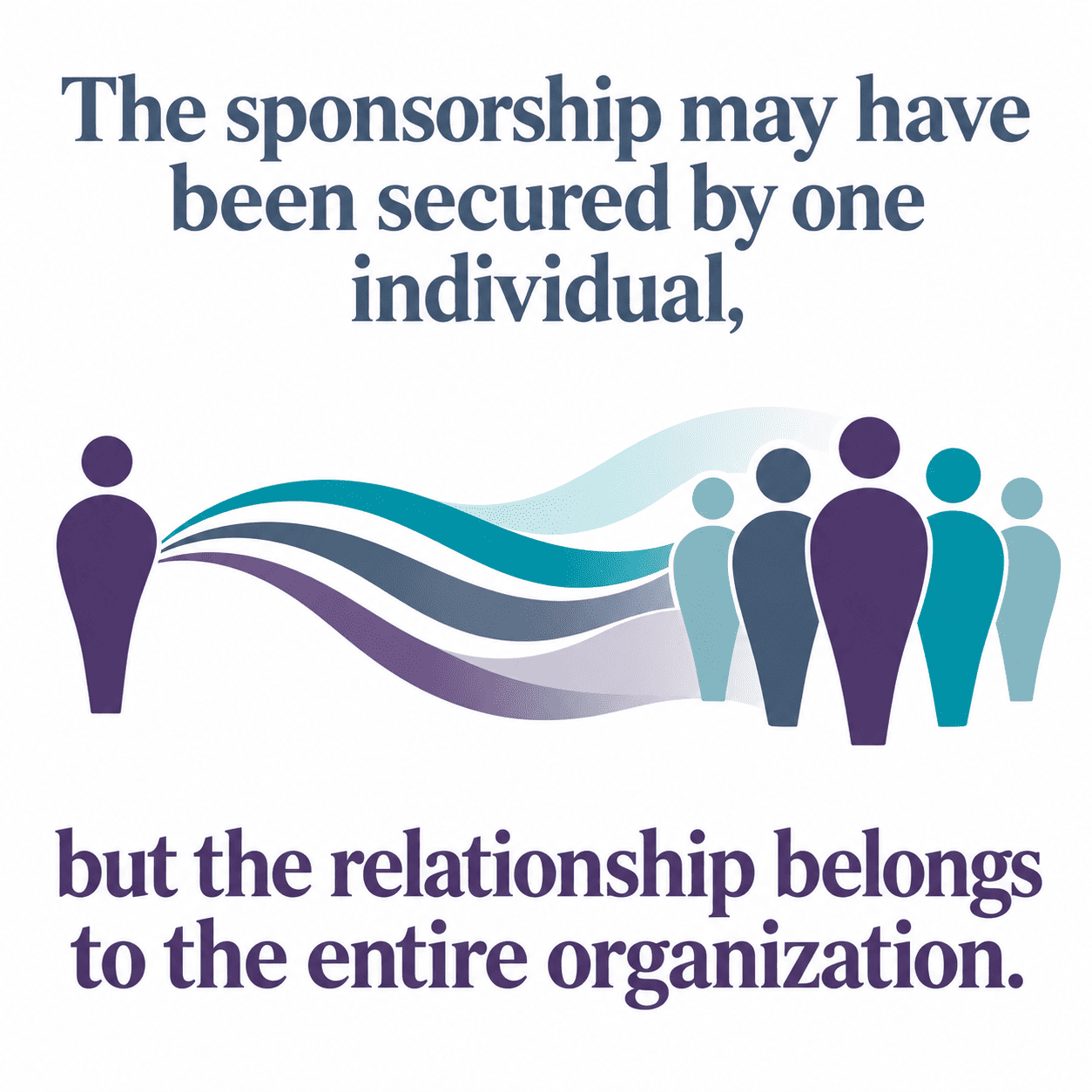
The sponsorship may have been secured by one individual, but the relationship belongs to the entire organization.
How Overpromising Sponsorship Benefits Can Hurt Sponsor Retention
Many organizations assume that adding more benefits makes a sponsorship opportunity more attractive.
More visibility, more recognition, more customized experiences, and more reports. The intention is understandable. Organizations are trying to create value. Unfortunately, every additional promise creates additional work. Sponsors would much rather receive five benefits delivered exceptionally well than twenty benefits delivered inconsistently. A great sponsorship experience doesn’t come from promising everything.
It comes from consistently delivering what matters most.
How Sponsor Communication and Impact Reporting Support Renewals
Sponsors understand that plans change. Events get rescheduled. Programs evolve. Unexpected challenges emerge. Most sponsors face similar realities within their own organizations. What they remember is how those moments were handled.
- Were they informed?
- Were they included in conversations?
- Did communication feel proactive rather than reactive?
- Did they receive evidence that their support made a difference?
Industry experts consistently identify communication, stewardship, fulfillment reporting, and demonstrating value as key drivers of sponsor renewal and retention. Strong reporting and relationship management help sponsors understand the value of their investment and support future funding decisions.In our experience, some of the most meaningful sponsor interactions are often the simplest:
- A photo from a student event.
- A participant success story.
- A quick update before a sponsor has to ask.
- A sincere thank-you call.
- An invitation to see a program in action.
These moments build connection. And connection builds trust.
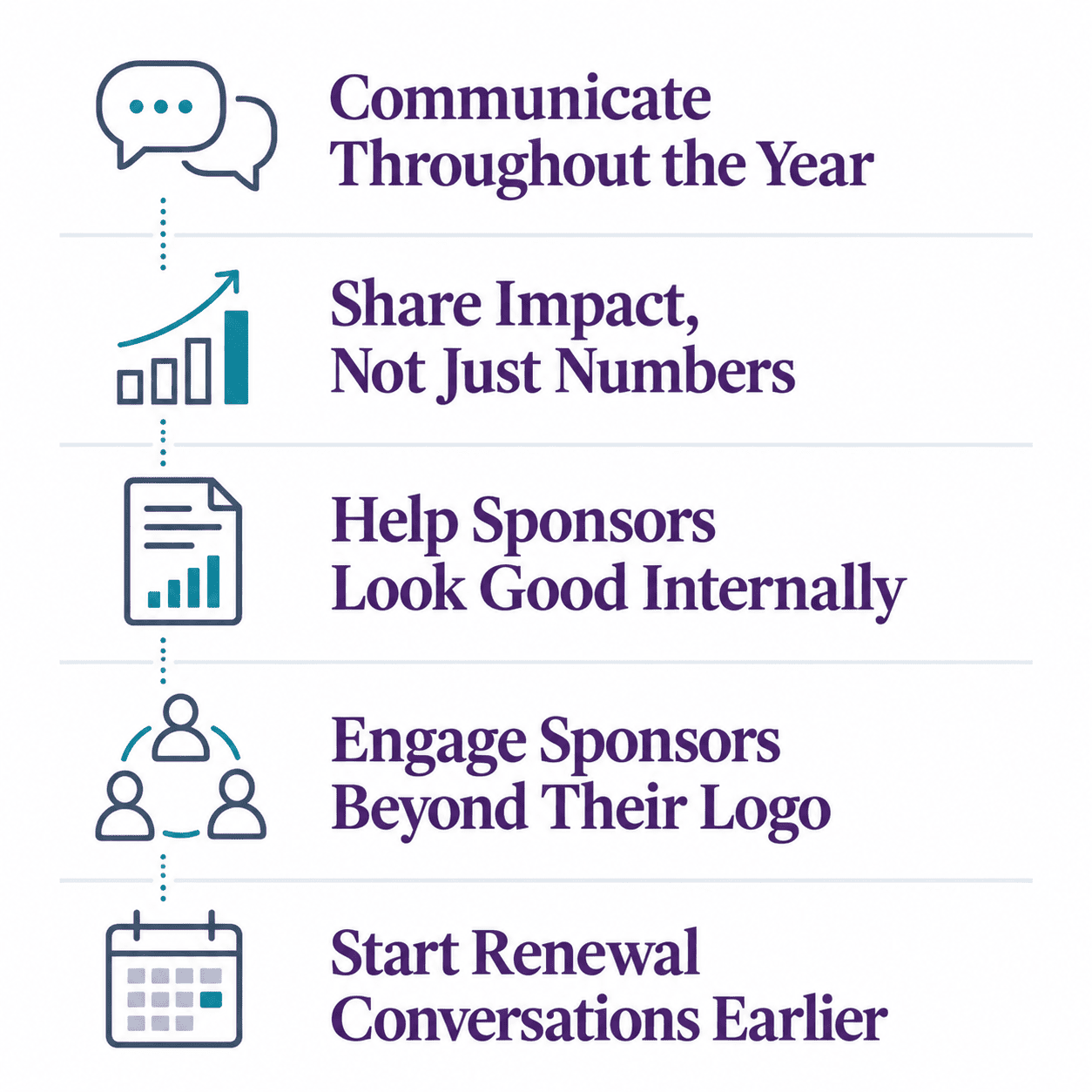
Five Sponsor Retention Strategies to Keep Sponsors Coming Back
Many organizations invest significant energy in securing sponsors but have no formal strategy for retaining them. The good news is that sponsor retention doesn’t require a larger team or a bigger budget. It usually comes down to intentional stewardship.
- Communicate Throughout the Year
One of the easiest ways to strengthen sponsor relationships is to stop viewing communication as an annual activity. Sponsors shouldn’t hear from you only when renewal season arrives. Sharing photos, program updates, success stories, media coverage, or important milestones throughout the year helps sponsors stay connected to the impact they’re helping create. Small updates often build stronger relationships than one large report delivered at year-end.
- Share Impact, Not Just Numbers
Attendance figures, impressions, and engagement metrics have value. But what sponsors often remember are the stories. How did their support help a student succeed? How did it strengthen a program? How did it contribute to a stronger community? Combining meaningful stories with measurable outcomes helps sponsors understand both the emotional and practical value of their investment.
- Help Sponsors Look Good Internally
The individual managing your sponsorship often needs to demonstrate value to their own leadership team.
Make that easy. Provide photos, testimonials, impact summaries, media mentions, and key metrics they can share internally. Well-prepared sponsorship reports help sponsors demonstrate return on investment and support future funding decisions. When a sponsor can clearly showcase the value of the partnership, renewal conversations become much easier.
- Engage Sponsors Beyond Their Logo
Many sponsorship programs focus heavily on visibility. The strongest partnerships create participation.
Look for opportunities to involve sponsors in volunteer activities, program visits, student engagement opportunities, celebrations, or knowledge-sharing events. The more connected sponsors feel to your mission, the stronger the partnership becomes.
- Start Renewal Conversations Earlier
Too many organizations wait until an agreement is nearly complete before discussing next steps. Instead, begin the conversation months before renewal decisions need to be made. Talk about successes. Reflect on lessons learned. Explore future opportunities. Discuss shared goals. When renewal is approached as a conversation about growth instead of another funding request, partnerships often deepen. At this stage, many organizations discover they have strong sponsor intentions but inconsistent stewardship practices.
It’s worth taking a moment before your next renewal conversation to consider what’s working well and where your team could use more support. If you’re unsure where to start, the AdvanceU Sponsorship Accelerator Self-Assessment can help you spot strengths and gaps in how you manage sponsor relationships.
Assessing Your Capacity to Retain Sponsors
Before pursuing additional sponsors or developing increasingly complex sponsorship packages, pause and ask:
- Do we clearly understand the value we offer sponsors?
- Do we have the capacity to deliver our commitments consistently?
- Are sponsorship roles and responsibilities clearly defined?
- Can we effectively measure and communicate impact?
- Do we have a strategy for stewarding sponsors after the agreement is signed?
The answers often reveal opportunities organizations haven’t previously considered. More importantly, they help build sponsorship programs that can grow sustainably.
Building Long-Term Sponsor Relationships
Organizations sometimes become so focused on acquiring sponsors that they lose sight of what sponsors are really looking for. They’re looking for trusted partners who communicate consistently, follow through on commitments, share meaningful impact, and make it easy to say yes again. The encouraging news is that none of those qualities depend on the size of your organization, your budget, or your event. They come from being intentional, responsive, and committed to creating a positive sponsor experience. That’s what transforms sponsorship into partnership. And that’s what turns sponsors into long-term champions of your mission.
Building a Sponsorship Program That Keeps Sponsors Coming Back
Knowing what helps sponsors stay is one thing. Making it happen consistently across your organization takes clear responsibilities, realistic commitments, and a shared understanding of what a successful partnership looks like.
Before your next renewal conversation, consider:
- Does everyone understand what you’ve promised and who will deliver it?
- Are you offering benefits your team can consistently fulfill?
- Can you show sponsors what their support has achieved?
- Do you have a plan for maintaining the relationship throughout the year?
If those questions reveal gaps, they can help you decide where to focus next. You may need tools to assess your current approach, time with your team to work through key decisions, or support putting plans into practice.
The AdvanceU Sponsorship Accelerator offers free resources, facilitated In-Services, and Integrated Projects to help you take that next step. Whether you’re clarifying what you can offer or strengthening how you deliver and maintain partnerships, you can find support that fits where your organization is today.
AI Transparency Statement: AdvanceU 1st Consultants used generative artificial intelligence (AI) to support research, brainstorming, drafting, and editorial refinement of this article. The ideas, professional judgment, analysis, recommendations, and final content review remain the responsibility of AdvanceU 1st Consultants.
.
Lorem ipsum dolor sit amet, consectetur adipiscing elit. Ut elit tellus, luctus nec ullamcorper mattis, pulvinar dapibus leo.
No Comments