If Advancement Looks Expendable. . .

START WHERE DECISIONS ARE MADE

Sit in on a budget conversation led by a VP Finance and the priorities are clear:

– Educate students.
– Keep the lights on.
– Cover salaries.
– Balance tuition and fees.

That’s the core.

Advancement doesn’t obviously sit in that list.

– It doesn’t teach a class.
– It doesn’t keep the campus running day to day.

So, in that lens, it can look expendable.

And in some institutions right now, it’s being treated that way.

Not because it doesn’t matter. Because it isn’t clearly understood.

THIS ISN’T NEW: BUT IT MATTERS MORE NOW

This isn’t a new problem.

Advancement has always operated with a degree of ambiguity.

– Busy teams.
– Important work.
But not always a clear, shared understanding of how that work contributes to institutional sustainability.

In stable environments, that ambiguity is more easily tolerated.

In constrained ones, it gets exposed.

Across Canada, institutions are under increasing pressure to demonstrate value, impact, and relevance; not just internally, but publicly and politically (Universities Canada).

At the same time, sector data shows public funding has declined significantly over time, increasing reliance on tuition and other revenue sources (Stats Canada).

WHAT ADVANCEMENT ACTUALLY DOES (AND DOESN’T DO)

The relationships that sustain an institution are not owned by one function.

They are built across it:

– Faculty who maintain long-term relationships with alumni and industry

– Student services teams who shape student success, leadership, and outcomes

– Institutional leadership who carry key relationships with government and external constituents

These are real, valuable connections.

But they are often distributed, informal, and not consistently aligned.

Without coordination, they remain fragmented.

Advancement doesn’t replace this work. It brings it together.

It connects the institution to the world beyond its walls.

This aligns with how Advancement is defined across the sector as the function responsible for building understanding and long-term support among alumni, donors, and external communities (CASE).

It aligns alumni, donor, partner, and community relationships into something more coherent.

And it ensures that what happens inside the institution is understood outside of it.

Advancement tells the story of the institution:

– Why it matters.
– And why it is worth investing in.

Advancement doesn’t create the institution’s value. It makes sure it is seen, understood, and supported.

Without that integration, institutions don’t lack relationships. They lack alignment.

WHAT HAPPENS WHEN THIS ISN’T CLEAR

When Advancement’s role isn’t clearly understood:

– Relationships remain disconnected

– Stories are inconsistent

– External audiences don’t see the full picture

– Support doesn’t build the way it could

Internally, the result is predictable:

Advancement looks like activity. Not infrastructure.

And, in constrained environments, activity is easier to cut.

OVER THE PAST FOUR WEEKS: WHAT THIS MEANS IN PRACTICE

Over the past four weeks, we’ve been unpacking what it takes to move from activity to something that is clearly understood and protected.

Week 1: Leverage: Not Everything Carries Equal Weight

If we can’t show which activities actually protect or grow the institution, everything looks the same.

What you can do today:

– Identify the few activities that directly influence revenue stability or growth

– Stop presenting everything equally

– Frame your work in terms leadership uses risk, stability, flexibility

Week 2: Case: If the Story Doesn’t Hold, Nothing Compounds

When different parts of the institution tell different stories, every conversation starts from zero.

What you can do today:

– Align leadership around what matters most right now

– Ensure that message carries across teams

– Focus on consistency over volume

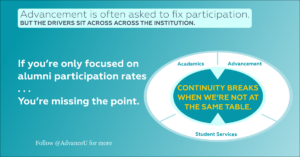
Week 3: Continuity: Relationships Should Build, Not Reset

Engagement should move from student > alumni > donor.  When it doesn’t, Advancement inherits the gap.

What you can do today:

– Identify one key transition point where connection drops

– Fix that before adding new tactics

– Focus on continuity, not just engagement

Week 4: Partnerships: Capacity, Not Coordination

Without structure, partnerships create work. With clarity, they create flexibility.


What you can do today:

– Define what you can offer clearly

– Set basic alignment and value guardrails

– Prioritize partnerships that build capacity

CLOSE

We don’t control enrolment.

We don’t control funding.

But we do control whether our value is clear.

Because institutions don’t protect what they don’t understand.

LET'S DO SOMETHING ABOUT IT TOGETHER

If this reflects what you’re seeing, the next step isn’t more activity.

It’s clarity.

That’s where we start: with a KIST Clarity Call.

                Pommashea Noel-Bentley                                     Scott Blythe

No Comments

Post a Comment